
With the rise of digital marketing, companies are always trying to balance the work of brand and performance marketing. One provides long-term reputation, while the other provides short-term results. However, in many cases, businesses get lost in the art of storytelling due to having too much data or too much story. To truly scale in today’s competitive landscape, marketers need to know how to integrate these two forces. This paper discusses the complementarities between the two approaches, discussing the pitfalls of overemphasizing one. On the other hand, developing a strategy that focuses on both brand loyalty and bottom-line performance ensures that.
What is Growth Marketing?
Growth marketing takes a different approach. It focuses on long-term growth and building customer loyalty. Instead of chasing quick sales, it builds meaningful and lasting connections with customers.
By 2025, nearly half of startups will rely on growth marketing to grow their business (industry reports).
- The big picture: It prioritizes customer satisfaction over short-term profits.
- Example: A music app sends engaging emails, and users naturally recommend it to friends.
- Why it works: It builds trust and loyalty that continues to grow over time.
- Who uses it: Many successful digital platforms rely on growth-based strategies.
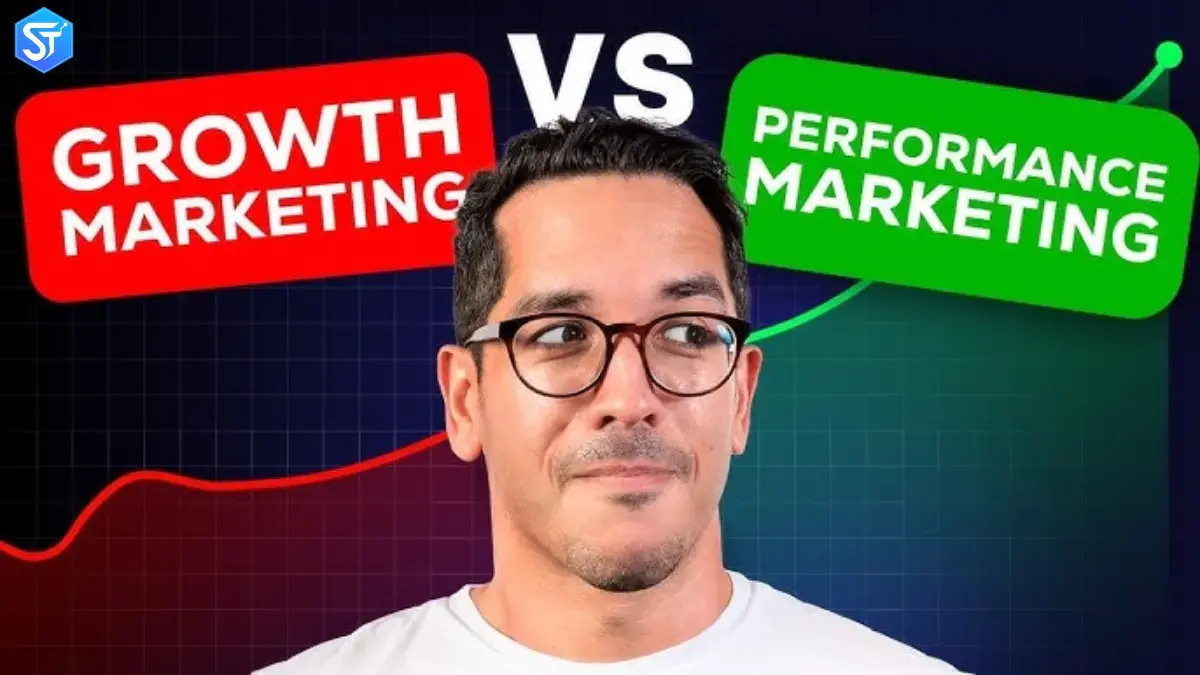
This idea clearly illustrates another difference between growth marketing and performance marketing. Growth focuses on loyalty, while performance focuses on speed.
At Lingaya’s BBA in Marketing, students learn growth strategies through practical and interactive classroom experiences.
What is performance marketing?
Performance marketing, on the other hand, is about tangible results. It’s action-based, meaning clicks, conversions, leads, and purchases. Every dollar is tracked and every campaign is evaluated by its level of ROI. This strategy is data-driven, algorithm-driven, and analytics-driven. It’s the science of marketing, the part that ensures that every ad impression or email campaign is directly linked to revenue. Performance marketing includes tools and channels like Google Ads, paid social media, affiliate marketing, email automation, and more, all aimed at converting interest into real results.
You may also like: WeChat Marketing: Top Social Media Platform (A Simple Guide)
The issue of a one-sided approach
When brands focus solely on image. While brand marketing is about emotional substance, it’s sometimes difficult to focus on building a brand without just the numbers. There are companies that spend a lot of money on creating beautiful images, artistic stories, or engaging websites. But they still fail to consider important issues like search engines, user experience, or conversion paths. The result? Beautiful campaigns that attract rewards — but not customers. This imbalance of brand over content is like building a great ship without a steering mechanism. Because it’s a beautiful-looking ship that’s going nowhere.
When brands are solely performance-oriented
However, on the other hand, a purely performance-oriented mindset can transform your brand into a machine-efficient, data-driven but hollow soul. These brands generate clicks and conversions, but they don’t build relationships and loyalty. Once customers make a purchase, they rarely come back because they don’t connect with the brand’s values or story. In the long run, brands that thrive on display won’t be able to compete in saturated markets because they will simply be brands that offer low prices and convenience. They lack identity or direction, so they can be forgotten when the competition comes along with a better deal.
The Coexistence of Brand and Display
The magic really comes when brand marketing and display marketing collaborate. One builds awareness and emotional trust, the other transforms trust into measurable results. Brand marketing is the reason for your business and display marketing is the form of your business. Your campaigns are more effective when the message is relevant. Telling a story makes your existing customers more likely to see, click, and convert your ads. Similarly, display campaign data can provide useful insights to strengthen brand storytelling. This two-way relationship makes marketing a self-perpetuating growth cycle – one side builds the other.
Creating a balanced strategy
Align goals and KPIs Initially, brand and performance efforts should be part of a single ultimate goal, which is business growth. Establish specific KPIs on both aspects: awareness, such as measuring brand recall, reach, and brand marketing sentiment; and performance, such as measuring conversions, cost per acquisition (CPA), or return on ad spend (ROAS). When these KPIs are in alignment, all marketing activities will be integrated into a unified strategy.
Read More: WeChat Marketing: Top Social Media Platform (A Simple Guide)
Establish a consistent brand personality
Establish the meaning, purpose, and tone of your brand voice before launching ads or content. Any message, whether it’s a banner ad or a social post, should be based on your values and narrative. Your display ads should feel like your brand. The point is consistency: no matter the medium, your audience is expected to recognize you immediately.
Let data inspire creativity
Display marketing is a goldmine of information about what people respond to, when they respond, and what drives their response. Use that information to tell your brand story. For example, if your analytics show that you have a high response rate for environmentally friendly messages, develop that theme as part of your brand identity and long-term communications strategy.
Drive performance goals using brand channels
Brand channels like YouTube, Instagram, or content marketing are also measurable. The presence of modern tools, including programmatic advertising, influencer analytics, and sequential storytelling, allows brand campaigns to be tracked. Multiple touchpoints in customer experience, awareness-raising, and engagement can now be measured, and creativity can be combined with accountability.
Balancing short-term and long-term benefits
Performance marketing delivers short-term benefits, while brand marketing delivers long-term sustainability. Companies looking for rapid change often fail to create them. The most effective marketing leaders design campaigns in terms of both immediate revenue and brand performance to meet future demands. It’s not a matter of choosing between the two, but of creating an explosion that’s here to stay.
Recommended to Read: SEO vs GEO vs AEO: Key Differences & How to Optimize For All
The Future of Marketing: The Road to a Whole Brain Marketing.
Thanks to advances in technology, the line between brand and performance marketing is increasingly blurred. Emotional storytelling can now be combined with hard metrics through tools like AI-powered personalization, first-party data analytics, and cross-channel attribution.
The contemporary consumer is demanding personalization and authenticity. They want brands that touch their hearts and at the same time create immediate value. Marketers on the new frontier of business development will be able to merge these expectations so that they can not only create beloved brands but also profitable brands on a regular basis.
Conclusion
At the end of the day, it’s not brand vs. performance, but brand + performance. Performance is the pulse that keeps your brand alive; your brand is the heartbeat of your company. The combination of the two is the key to long-term success.
By combining storytelling elements with strategy, emotion with analytics, and vision with measurement, businesses have the opportunity to reach optimal ratios that will help build identity, make things happen, and establish meaningful, long-term relationships with customers, without the need to declare strategy, declare emotions, or demonstrate vision.
Also Read: 15 Ways Social Media Influencers Make Most Money
FAQs:
Q1. What is the main difference between performance marketing and brand marketing?
Brand marketing is more long-term and emotionally connected while performance marketing is short-term and results-based, such as conversions and ROI.
Q2. Why is it dangerous to do only performance marketing?
Because performance campaigns can only generate short-term sales without building long-term customer loyalty, without a strong brand identity, performance campaigns are essential.
Q3. Is it possible to measure brand marketing?
Yes, by using metrics such as brand awareness, sentiment analysis, engagement rates, and assisted conversions across different touchpoints.