
Search engine adaptation (SEO) plays an important role in achieving risk in today’s digital scenario. Nevertheless, how you get up in the rankings decides whether your success is or goes away. Like an old Western film, SEO has its own hero, villain and people working in shadow.
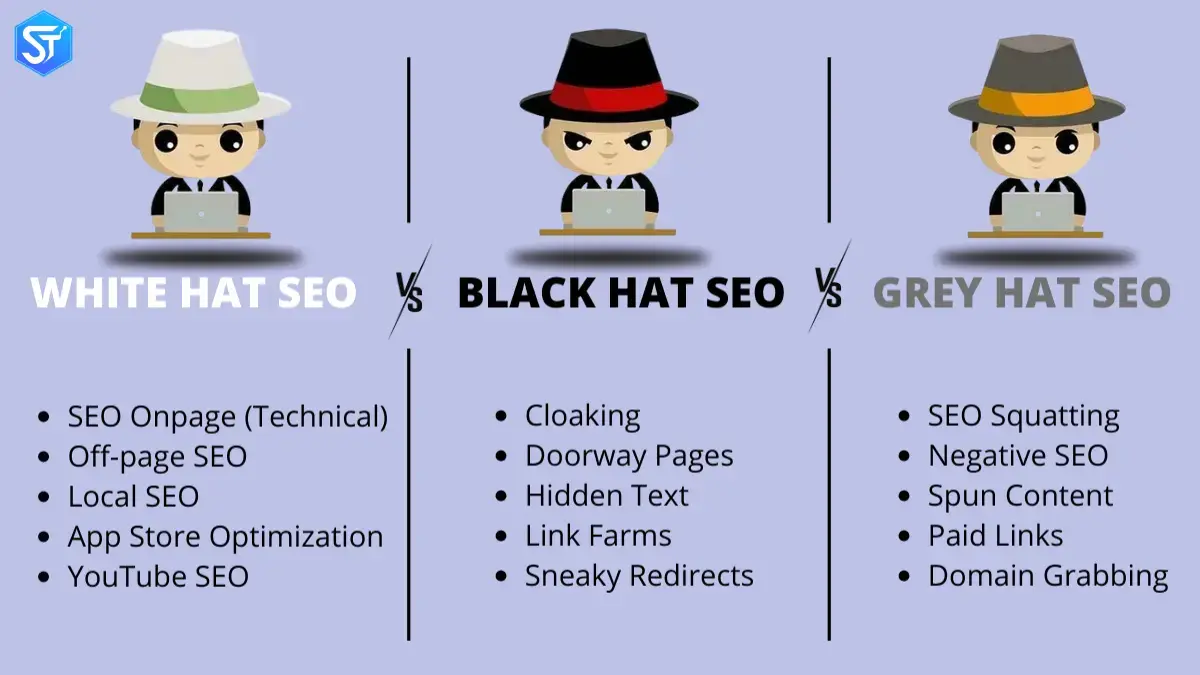
These approaches fall into three well -recognized categories: white hats, black hats and gray hats SEO.
Let’s see what each style means, why it matters, and how it chooses Tactics Digital Markets.
Origin of word “Hat”
The words “White Hat” and “Black Hat” are found in Western films of the 1920s, where good people wore white hats, while criminals wore black hats. This simple scene helps the audience to explain the difference between a hero and a villain immediately.
Over the years, the concept spread to various industries, such as cyber security, and eventually found its home in SEO.
In the SEO world specifically:
White hat SEO refers to ethical, guideline-approved practices.
Black hat SEO refers to deceptive or misleading methods.
Gray hat SEO falls into the middle ground, mixing elements of both.
Understanding these categories is important because they shape the risks you take, the results you achieve, and the reputation you build over time. So in this article, we will discuss the key differences between White Hat, Black Hat, and Gray Hat SEO. So in this article, we will discuss the key differences between White Hat, Black Hat, and Gray Hat SEO.
What does white hat SEO mean?
White Hat SEO means following the rules and achieving success correctly. The selecting this path uses moral strategies that correspond to the search engine policies. Their focus is on long -term reliability, permanent ranking and stable development.
What does Black Hat SEO mean? Black Hat SEO uses aggressive methods that break the rules. These strategies can cause quick results, but they often come up with severe risks. Eventually, the search engines hold, and the short -term victory disappears. Google uses both websites and their Crawler (Googlebot) and real human critics to evaluate strategies. If your site violates Google’s webmaster guidelines, it is at risk of being removed or removed from the search results. The doorway pages are thin, low-value pages designed to rank for specific keywords and push visitors to another destination. They mislead users, and Google clearly considers them a black hat technology.
What is Gray Hat SEO?
Gray hat SEO sits in a vague space between white hat and black hat practices. Professionals disagree on its exact definition, but most agree on two main ideas:
It is a combination of both white hat and black hat strategies.
It is a tactic that is currently considered acceptable but could be marked as harmful in the future as search engines evolve.
The common thread? Gray hat SEO is neither clearly right nor wrong.
It represents strategies that you would not openly disclose to Google, but they are not always subject to penalties. These tactics are intended to gain an edge in rankings, without being overtly manipulative or purely ethical.
Why These SEO “Hats” Matter
The type of SEO you choose affects not only rankings but also trust and brand reputation. White hat SEO builds credibility over time and supports long-term authenticity signals, as the platform recognizes trust through features like Meta Verified. Black hat SEO offers quick wins but often short-term success. Gray hat SEO offers flexibility but uncertainty.
White Hat, Black Hat, and Gray Hat SEO Techniques
White hat SEO methods include:
- Creating valuable, original content that matches user intent.
- Performing keyword analysis to find natural and relevant search queries.
- Optimizing titles, meta descriptions, headers, and images.
- Improving site speed and ensuring that the layout runs smoothly on mobile devices.
- Earning backlinks from trusted and industry-relevant sources.
- Designing a clear site hierarchy with easy navigation.
- Refreshing content regularly to keep it accurate and helpful.
Black hat SEO tactics you should avoid include:
- Unnaturally pushing keywords to increase rankings.
- Placing hidden text or invisible links to mislead search engines.
- Using link networks to build high-quality backlinks.
- Showing different content to users and search engines (cloaking).
- Copying or reusing content from other sites.
- Relying on automated tools to create content or backlinks.
- Engaging in paid link schemes to manipulate ranking positions.
Key features of gray hat SEO
Keyword usage: Placing keywords in a somewhat forced manner – not as extreme as keyword stuffing but not entirely natural.
Link building: Obtaining backlinks through questionable methods such as link exchanges or private blog networks, which are not completely prohibited but pose risks.
Content Tactics: Producing mostly original content with minor manipulations, such as lightly spun text that is not completely duplicated.
Soft cloaking: Delivering slightly different versions of content to users and search engines, without completely hiding the real content.
How Google Frustrates Black Hat SEO
Google uses both its crawler (Googlebot) and real human reviewers to evaluate websites and their SEO strategies. If your site violates Google’s Webmaster Guidelines, it is at risk of being removed or dropped from search results.
This penalty is called a manual action. Visitors won’t know why your site lost rankings, but you can check Google Search Console for a notification.
| S. No. | Black Hat SEO | White Hat SEO |
| 1 | Focus is placed on search engines, not people. | Focus is placed on human users while following rules. |
| 2 | Quick gains are expected. | Steady growth is achieved. |
| 3 | Keywords are stuffed to trick crawlers. | Keywords are researched and used properly. |
| 4 | Irrelevant backlinks are built. | Backlinks are gained from quality content. |
| 5 | Links are exchanged for rank. | Links are earned naturally. |
| 6 | Known as unethical SEO. | Known as ethical SEO. |
| 7 | Short-term results are targeted. | Long-term success is targeted. |
| 8 | Not approved by search engines. | Approved by search engines. |
| 9 | Google’s rules are ignored. | Google’s rules are followed. |
| 10 | Used: stuffing, cloaking, spam, hidden text, link schemes. | Used: research, analysis, better meta tags, fast speed, mobile-friendly. |
| 11 | Search intent is not met. | Search intent is satisfied. |
| 12 | Rankings are manipulated. | Rankings are gained organically. |
| 13 | User experience is harmed. | User experience is improved. |
| 14 | Quality content is not produced. | Quality content is created. |
| 15 | Trust is reduced. | Trust is increased. |
| 16 | Authority is lowered. | Authority is raised. |
| 17 | Disapproved by search engines. | Approved by search engines. |
| 18 | Duplicate content is used. | Relevant content is used. |
| 19 | High risk is involved. | Low or no risk is involved. |
| 20 | Irrelevant backlinks are common. | Relevant backlinks are common. |
Conclusion
The discovery like Google expects owners of the engine site to follow fair practices that provide the best user experience. This is the real key to long -term success.
Black hat SEO refers to practices that Google strictly prohibits. White hat SEO represents strategies that Google recommends and supports. Gray hat SEO sits in the middle, depending on whether you’re comfortable taking that risk.
If you ignore Google’s rules, your site could suffer from lower rankings – which is counterproductive to your goals. Investing your time in white hat SEO will result in fewer headaches and more reliable results over time.
Read More: .COM vs .ORG vs .NET vs .CO vs .IO: Which Top Level Domain is Better? (A Guide)
FAQs:
Q1. Is Grey Hat SEO Safe to Use?
Grey Hat SEO doesn’t completely break search engine rules, but it sits in a dangerous middle ground that can become detrimental if the algorithm changes. It carries fewer risks than Black Hat SEO, yet it often causes long-term problems. Use it with caution, especially when working on client websites.
Q2. Is buying links always black hat?
Yes. Paying for backlinks is against Google’s policies and is considered black hat SEO. It can give a quick boost in rankings, but the risk of penalties once discovered is very high.
Q3. What are Doorway Pages?
Doorway pages are thin, low-value pages that are designed to rank for specific keywords and push visitors to another destination. They mislead users, and Google clearly considers them to be a black hat technique.
Q4. What is cloaking in SEO?
Clooking occurs when a site presents a version of a page to search engines and a different version for visitors. This strategy tries to manipulate the ranking and is a serious violation of the quality guidelines of Google.