

Exact match domains (EMDs) are domain names that include the keywords that a website wants to rank for. For example, if you wanted to rank for “ocean of games,” owning a domain like oceanofgames.com would be considered an exact match domain. These types of domains were once a quick way to gain high visibility on search engines, but their effectiveness has declined over the past several years as SEO practices have evolved.
In the past, EMDs gave websites a strong advantage by directly signaling keyword relevance to search engines. This made it easier for businesses to rank highly by having keyword-rich domains like gtaforpc.com for GTA vice city game download for PC. However, with updates to Google’s algorithm, using an exact match domain alone no longer guarantees top rankings. Search engines now look deeper into content quality, authority, and user experience before deciding which pages are worthy of a high spot.
However, exact match domains can still provide some value when used correctly. They can improve click-through rates by clarifying the purpose of the site to users, but they should not be relied upon as the sole SEO strategy. Businesses today need to create strong, relevant content and follow SEO best practices rather than focusing solely on domain names. When combined with high-quality content and proper optimization, EMD can still play a role, but it cannot replace the importance of long-term SEO efforts.
What Does an Exact Match Domain Mean?
We will explain how to choose an exact match domain name for your business. An exact match domain is when a company chooses a name that includes a key keyword related to its business. Including this keyword in the domain can improve SEO and help the website show up in Google search results for that term.
Often, a business will purchase a domain that already has a useful keyword, which helps the site rank higher. Some businesses even intentionally choose exact match keywords in the domain, as this method works well for long-term rankings.
Example of an Exact Match Domain
besthikingshoes.com is an exact match domain (EMD). This domain points to a website that sells or reviews hiking shoes.
It is an exact match domain because the keyword (“best hiking shoes”) is the same phrase that people type when searching for hiking shoes online.
Other examples of exact match domains are:
- hotels.com — a site for booking hotels
- buyusedcars.com — a site that sells used cars
- bloggingtips.com — a site that gives blogging tips
- howtostartablog.com — a site that helps people start a blog
- cheapflightsbooking.com — a site that books cheap flights
- topfitnessgear.com — a site that sells or reviews fitness gear
Domains like apple.com or nike.com are brand domains, not exact match domains. When people search using brand names, those words are branded keywords.
Let’s understand with a small example
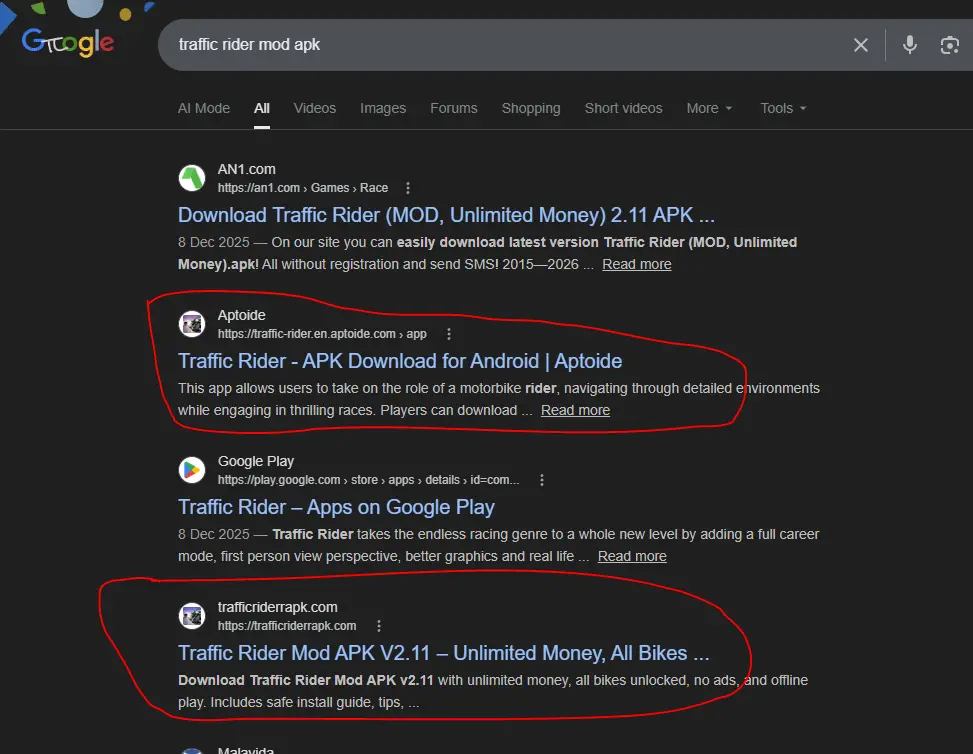
Imagine someone searches for “traffic rider mod apk” on Google. Many websites may use this exact keyword in their domain name, such as a site like trafficriderrapk.com. In the past, Google often ranked these types of domains higher because the keyword matched the search exactly.
Things work a little differently today. Google now focuses more on useful content and a good user experience. Even if a website uses an exact match domain, it still needs helpful content, clear information, and good website structure to rank well.
For example, if a website with the keyword “traffic rider mod apk” provides clear guides, realistic images, safe download information, and helpful tips for users, Google may still rank it well. But if the site only uses the keyword in the domain and provides poor or duplicate content, Google may not rank it high.
This example shows that exact match domains can still work, but only when the website also provides quality content and value for users.
Do Exact Match Domains Still Work? What Google Says…
Google now understands user intent and search language much better than before. In 2012, Matt Cutts announced an update that reduced the ranking power of low-quality exact match domains in search results.
This update didn’t just target exact match domains. It targeted websites that used EMD and engaged in spam tactics like thin content, poor SEO, and poor site quality.
The main point was clear: many SEOs bought keyword-rich domains, built simple sites, and filled them with little or no useful content. Over the years, Google has made changes to focus more on high-quality and relevant content, rather than just domain names.
Before this change, Matt Cutts warned the SEO industry that the update was coming. Later, a tweet from Google’s head of webspam confirmed that relying solely on keywords in domain names could hurt rankings.
On September 28, 2012, Cutts officially shared the EMD update on X. His tweet read, “New Exact Match Domain (EMD) algorithm significantly impacts 0.6% of English-US queries. Not related to Panda algorithm or Penguin algorithm.”
So, does EMD still work? The truth is mixed. Exact match domains can provide a little boost, but without strong content and good SEO, they don’t help much anymore.
Also Read: Content Amplification Strategy: Tools for Improving Your Content’s Reach and Engagement
Types of Exact Match Domains
1. Single Keyword EMD
Single keyword exact match domains are site names that exactly match a single keyword or search term. For example, if you sell shoes, a name like shoes.com is a single keyword EMD. In the past, these domains were very popular in SEO because they helped sites rank quickly for that term. They still have value today, but they work best when combined with useful content and good SEO work.
2. Multiple Keyword EMDs
Multiple keyword EMDs consist of two or more words that make up a search query. For example, if you have a cafe in Mumbai that sells organic coffee, a name like organiccoffeemumbai.com could target that phrase. These domains can help you rank for long-tail keywords, but you need to balance them with strong content and SEO. Search engines now look at relevance and user experience more than just exact keyword match.
3. Dashed And Non-Dashed EMDs
Dashed and non-dashed EMDs depend on how the words appear in the name. The non-dashed version keeps the words together, like bestlaptops.com. The dashed version separates them with a hyphen, like best-laptops.com. Both can work well, but non-dashed names are generally easier to write and remember. Choosing one depends on availability and what feels good for your brand.
4. TLD Variations
TLD variations use different endings, such as .com, .net, or .in, with your chosen domain. This helps you protect your name, target local markets, and protect your brand. For example, if .com is not available, you can choose .in for India. Using more than one TLD prevents others from taking the same domain name. It is a good way to protect your brand and reach more users.
Further Reading: What Do You Need To Balance When Doing SEO? What Really Matters
Differences Between EMD And Non-EMD Domains
Exact match domains (EMD) use the same words that people search for in their main keywords on Google. Non-EMD domains focus more on branding, creativity, or a unique name. Knowing the difference can help you choose the right domain for your website’s goals.
User understanding
EMD clearly shows what the website is about. When people see the name, they quickly understand the topic. A non-EMD domain does not directly explain the topic, so the website should use good content and marketing to tell users what it offers.
SEO impact
EMD can attract visitors who search for a specific keyword in the domain. Non-EMD domains rely more on helpful content, strong backlinks, and proper SEO work to rank on search engines.
Easy to remember
Non-EMD domains often use short, creative, or catchy names. These names are easy for people to remember. EMD domains use obvious keywords, but sometimes they can seem simple or generic.
Potential risks
Some EMD websites try to repeat keywords too much. Search engines can see this as over-optimization and can lower rankings. Non-EMD domains are generally less prone to this problem.
When choosing between an EMD and non-EMD domain, think about your long-term plans, your brand, and your audience. Both options work well if you use them correctly.
Benefits of an exact match domain
An exact match domain is easy to understand and remember. The name tells users exactly what the website offers.
For example, a name like hotels.com or buyusedcars.com quickly tells people what they will find on the site. This makes the domain easier for visitors to remember.
In the past, EMD domains also helped websites rank on Google, even if the content wasn’t very strong. Because of this, many people bought keyword domains as an SEO tactic.
Some investors also bought these keyword domains and later sold them to businesses for profit. Many domain hosting companies also created special marketplaces where people could buy and sell valuable domain names.
Should You Buy an Exact Match Domain?
You can buy an exact match domain if you want, but don’t expect it to rank on Google on its own.
You still need to follow SEO basics like on-page, off-page, and technical work. If you’re targeting local search, you’ll also need to focus on local SEO.
An exact match domain doesn’t give you much ranking power, but it does help users. People can easily guess what your website offers just by looking at the domain name.
It’s also easy to remember, so visitors won’t forget it as quickly.
The challenge is that most of these domains are expensive. Many are already owned by people who later sell them for a profit.
Some cost a few thousand dollars, while rare domains can go for hundreds of thousands or even millions of dollars.
If you’re planning to buy one, choose a .com domain. Other extensions are less popular, can appear spammy, and are often more affected by Google’s exact match domain update.
Read More: What’s The Main Difference Between Internal Links vs. External Links (2026)
Conclusion
Exact match domains still play a role in SEO in 2026. They won’t automatically propel a site to the top, and they’ll never replace core SEO principles, but they can provide real value when you use them strategically. In low-competition or non-YMYL niches, EMDs often gain momentum quickly because they closely match user search intent, can appear as a branded signal to Google, and promote natural, keyword-focused anchor text without triggering over-optimization issues.
Results over time still depend on the basics: high-quality content, real authority, and a strong user experience. However, when you’re looking to test an idea, launch quickly, or compete effectively in a niche space, exact match domains can provide a clear strategic edge. The right decision depends on whether your priority is building a lasting brand or seizing short-term opportunities.
Final Thoughts
If you’re unsure about using EMD, choose a domain name that fits your brand and works well across all marketing channels. In the past, EMD has helped some sites rank faster. But today, Google is focusing more on quality and useful content. In the future, strong and helpful websites will rank higher than keyword-only domains.
FAQs: Questions & Answers
Exact match domains once offered simple SEO benefits, but now search engines like Google prioritize high-quality content, user intent, and relevance. Today, even with EMD, you should focus on strong content and comprehensive SEO efforts to achieve better rankings on search engine results pages (SERPs).
There are multiple options for exact match domains, including partial match domains, brand-focused names, or unique domain names relevant to your industry. Working with an SEO agency can guide you in finding the best optimization approach for your business.
Exact match domains are a bit expensive because they can help generate significant revenue if they rank well or are later sold. Choosing the right domain name opens up new opportunities to reach untapped customers. Google still values EMD, and a premium domain aligned with your niche can attract leads without the need for heavy advertising.
An exact URL match allows for minor changes to the link. It ignores things like tracking codes or additional parameters at the end of the URL. An exact URL match is strict. It examines the entire URL and counts every part, including query parameters.
The exact match domain (EMD) penalty is a Google update. It reduces the ranking of domains that use specific keywords but provide poor or spammy content. If a website doesn’t provide helpful information, Google can push it down in search results. Good content and proper SEO help avoid this problem.